
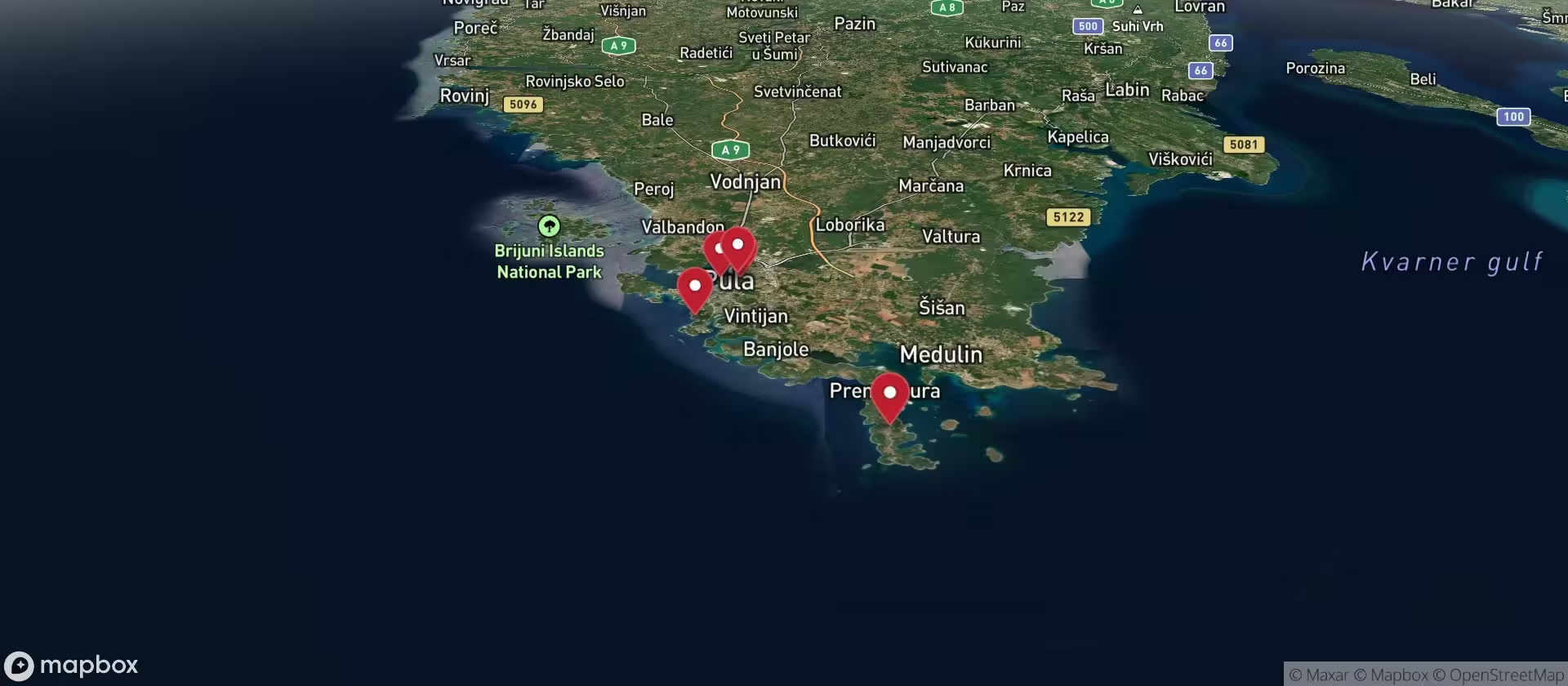
With a population of 82,000, Pula is today the largest and oldest city in Istria and is home to magnificent ancient monuments. Its rich cultural heritage, combined with modern tourist infrastructure and, not least, the allure of the blue Adriatic Sea, make Pula a highly attractive vacation destination.

Triumphal Arch
Historic Center
of Pula
The Triumphal Arch of Pula, also known as the "Golden Gate," was once directly connected to the city gate Porta Aurea (the Golden Gate), which was unfortunately destroyed in the 19th century. However, the name has not become obsolete, as the arch now aptly marks the entrance to Pula’s shopping district.
To explore the center of Pula with its many historical monuments and churches, you should plan on spending more than just a day.
Pula was originally founded as the Roman colony of Pietas Julia. As early as the 6th century, it was an important Byzantine naval port, and the city retained this strategic significance well into the 20th century. In 1150, the city submitted to Venetian rule and remained - except for a brief interruption from 1294 to 1319 - part of the Republic of Venice until its fall in 1797. It then came under Habsburg rule and was developed as a naval port.
Today, it remains an important Croatian port, as well as the administrative center of Istria and a university city.


Pula Amphitheater
The amphitheater in Pula - the jewel of this coastal city - is one of the six largest surviving arenas in the world. Under Emperor Vespasian, it was expanded in 79 AD to host gladiatorial combats and could seat 23,000 spectators. In the Middle Ages, tournaments were held here, while today the venue is used for more peaceful events such as open-air concerts and, in the summer, the opera festival and a spectacular open-air film festival, during which the Croatian film award "Golden Arena" is presented.
Since the arena is situated on a slope along the coast, the outer wall on the sea side has three stories, while the opposite side has only two. The well-preserved outer wall measures an impressive 29.40 meters at its highest point! The main arena is 68 meters long and 41 meters wide. Along the main axis, beneath the theater, were the corridors for the gladiators and the animal cages (or, in modern times, the opera singers).

There are no sandy beaches in Pula (the nearest ones are in Medulin), but there is a wide variety of pebble beaches (both coarse and fine), rocky beaches, concrete swimming areas, and grassy sunbathing areas.
Dogs are not allowed on official beaches. However, there is a separate dog beach in Saccorgiana Bay, a little further south on the Verudela Peninsula.
Pola and the Austro-Hungarian Naval Base
After the Revolution of 1848, the Venice Arsenal was no longer viable as an Austrian naval base, and a new location was sought. Emperor Franz Josef I favored the small town of Pola, which at the time had only about 900 inhabitants and whose municipal council ceded four large plots of land to the military free of charge. In 1856, he personally laid the cornerstone for the construction of a naval arsenal.
The subsequent expansion into the main Austrian naval port brought the city an incredible construction boom and a rapid population increase. The last census under the Habsburgs in 1910 recorded 58,560 inhabitants. All major buildings that still shape the cityscape today were connected to the expansion into a naval port. Some of these are worth mentioning, such as the shipyard, the engineering school, the naval hospital, the naval barracks, the naval officers’ club, the hydrographic office with its observatory, the train station, civilian schools, social housing, hotels, etc.
The outer harbor was located between the island of Brioni/Brijuni, 12 km away, and the mainland. The actual harbor covered 8.6 square kilometers and included all facilities essential for naval warfare. Around 1912, it received its first major radio telegraph station - Radiopola - whose signal reached as far as the Atlantic and the Red Sea.
With the Treaty of Saint-Germain, Pola, like the rest of Istria, came under Italian rule until 1945. The 1947 Paris Peace Treaty finally established that all of Istria would become part of the Yugoslav republic of Croatia.

Temple of Augustus
Temple of Augustus & Roman Forum
in Pula
The Temple of Augustus, dating from the 1st century AD, stands on the site of the former Roman forum. It is 17 meters long and only six meters wide, but with its 3 x 2 columns and the Corinthian capitals of the portico and the cella, it ranks among the finest examples of Roman architecture.
The small Arch of Sergius is a good 100 years older, featuring a winged goddess of victory and a frieze depicting a horse-drawn chariot.
Passing through the Porta Herculea - Pula’s oldest Roman monument, featuring a depiction of Hercules with a club - you reach the Fortress. This star-shaped fortress was built in the 17th century by the Venetians on the ruins of the Roman Capitol in the city center. It houses the Historical Museum of Istria. From its walls, you have a magnificent view of the city. Nearby are the remains of a theater and, further on, the Istrian Archaeological Museum. It is located in a park on the grounds of the former German School near the Porta Gemina.